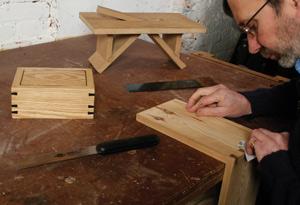
The simultaneous mechanical and visual elegance of well executed dovetail joinery is recognised as a hallmark of fine craftsmanship the world over. Perhaps it is the ability of this ancient joint to appeal to both sides of the brain at once that has made it such an enduringly popular feature of fine cabinetmaking.
It seems appropriate, therefore, that a set of chisels designed specifically for preparing these joints should also…
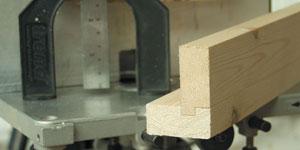
The spline dovetail is a joint that can be used both for strength and decoration. It looks especially attractive on small carcases and is very popular with boxmakers. It’s simple to make, and the only tools needed are a router fi tted with a dovetail cutter, and a tilting arbour table saw. However, you do need to make a simple jig fi rst. This can be modifi ed to suit your particular router/ guidebush combination. The design here uses a…
This week, the Health and Safety Executive (HSE) launched its campaign ‘Asbestos: The hidden killer’, which is aimed at making trade professionals aware of asbestos and the damage it can cause to their health and lives.
Every week 20 tradesmen, including carpenters and joiners, die from asbestos-related diseases caused simply by breathing in asbestos fibres. Asbestos-related disease is the biggest single cause of…
This technique is a simple method for joining two pieces of timber. Although this joint has many applications, it’s particularly useful for a bearer on the inside of a cabinet to secure a solid wood top in place. In this case, screws would fit into slots cut in the bearer to secure the top down. The slots allow the top to expand with the varying humidity in addition to preventing it from cupping or bowing.
It’s most useful,…
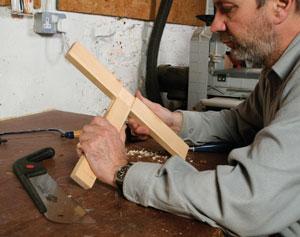
The bridle joint is also referred to as an ‘open’ or ‘slot’ mortise-and-tenon joint. This is because the mortise is open-ended and the tenon may be slid into it sideways. The joint can be used on corners, either cut square or mitred, where it’s signifi cantly stronger than a halving joint by virtue of its large gluing area.
Tools you’ll need to cut bridle joints:
• Try square
• Pencil
•…
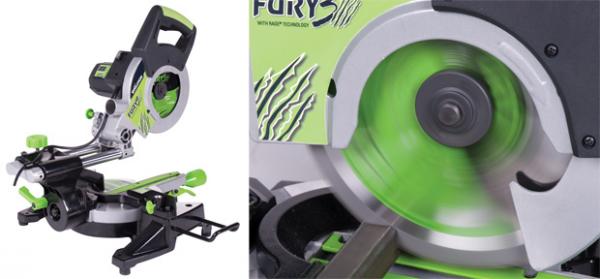
Evolution’s FURY 185mm Circular Saw and FURY3 210mm Sliding Mitre Saw are a great combination for the home user who demands high performance coupled with excellent value. Featuring the same revolutionary multipurpose technology as the saws in Evolution’s professional range (Evolution Build), the FURY and FURY3 will cut Steel, Aluminium and Wood (even wood with nails), using just one blade.
We’re on the cliffs above Blackgang Chine on the Isle of Wight. Behind us, to the north, the skies are bruised and heavy with the threat of approaching rain. But before us, the glass top of a table — part-silvered by the autumn sun — reflects the passage of billowing clouds as they catch the wind in their huge sails and trail their shadows southwards over the mirrored sea, over the horizon, and over the edge of the glass.…
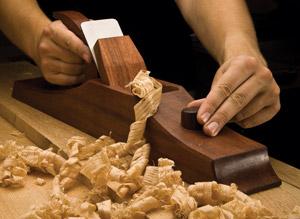
I made my try plane from bubinga (also called African rosewood), although any durable hardwood will fi t the bill. I could only source 50mm thick planks, so I had to laminate stock together to get thick enough material. You will need a piece 600 x 75 x 62mm for the centre block, as well as two cheeks measuring 600 x 75 x 8mm. Rip the timber down to size on the bandsaw, then glue up the pieces to form the centre block.
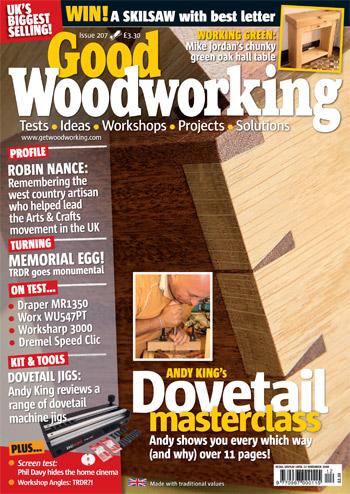
Andy King’s handiwork dominates the cover of this month’s Good Woodworking as our tiger on the tools takes over 11 whole pages of the magazine to investigate making dovetails both by hand and with the use of jigs. We hope we haven’t embarrassed Andy by calling it a masterclass, but having subbed and proofed those pages, we think he’s done one incredibly thorough and entertaining job. Nice work, Andy.
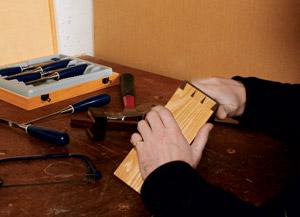
There are several varieties of dovetail joint, but perhaps the most common – and the most familiar – is the lapped dovetail. This is used when you want to hide the joint on one side, but make it visible on the other. Its most common use is in drawer construction. Here the mechanical strength of the joint is needed to fi x the sides to the drawer front, but you don’t want the joint to be visible when the drawer is closed.…